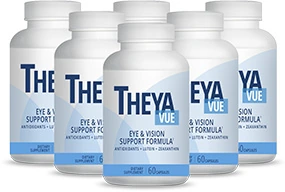
TheyaVue Official Website › Supplement Facts
Supplement FactsTheyaVue Supplement Facts, Transcribed in Full
Each TheyaVue serving is one capsule, and a bottle holds sixty.
Fourteen nutrients have an amount and %DV, and a 240.5 mg proprietary blend covers ten more. At two capsules a day, a day gives twice each printed figure.
For what each one does, see the TheyaVue ingredients.
Transcribed from the panel photographed on the bottle and reproduced beside the table.
The TheyaVue panel as printed, and as taken
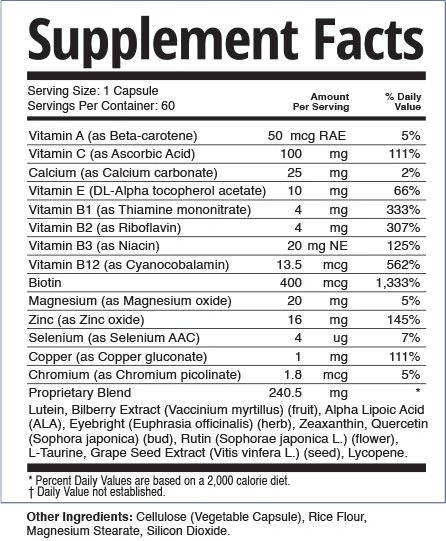
The panel header reads Serving Size: 1 Capsule, Servings Per Container: 60. The directions on the same bottle read one capsule twice daily. Those two lines together are the most important thing on the label and they are printed in two different places, which is how the arithmetic gets missed.
Sixty capsules at two a day is thirty days, which is also what the seller calls a one-bottle supply, so the three figures agree. The percent daily value column does not: it is per serving, and a serving is one capsule, so every percentage on the bottle is half the daily figure.
The table below carries both columns side by side. Nothing in the first two is this desk's arithmetic; the third is.
Every TheyaVue nutrient with a declared amount
| Nutrient | Per capsule | Percent DV, per capsule | Per day, at two capsules |
|---|---|---|---|
| Vitamin A (as Beta-carotene) | 50 mcg RAE | 5% | 100 mcg RAE |
| Vitamin C (as Ascorbic Acid) | 100 mg | 111% | 200 mg |
| Calcium (as Calcium carbonate) | 25 mg | 2% | 50 mg |
| Vitamin E (DL-Alpha tocopherol acetate) | 10 mg | 66% | 20 mg |
| Vitamin B1 (as Thiamine mononitrate) | 4 mg | 333% | 8 mg |
| Vitamin B2 (as Riboflavin) | 4 mg | 307% | 8 mg |
| Vitamin B3 (as Niacin) | 20 mg NE | 125% | 40 mg NE |
| Vitamin B12 (as Cyanocobalamin) | 13.5 mcg | 562% | 27 mcg |
| Biotin | 400 mcg | 1,333% | 800 mcg |
| Magnesium (as Magnesium oxide) | 20 mg | 5% | 40 mg |
| Zinc (as Zinc oxide) | 16 mg | 145% | 32 mg |
| Selenium (as Selenium AAC) | 4 mcg | 7% | 8 mcg |
| Copper (as Copper gluconate) | 1 mg | 111% | 2 mg |
| Chromium (as Chromium picolinate) | 1.8 mcg | 5% | 3.6 mcg |
The first three columns are the label's own. The fourth is the amount a person following the directions receives in a day, which is the panel figure doubled.
The TheyaVue proprietary blend, and what that line means
One line, 240.5 mg, ten names. In the panel's own order:
- Lutein
- Bilberry Extract (Vaccinium myrtillus) (fruit)
- Alpha Lipoic Acid (ALA)
- Eyebright (Euphrasia officinalis) (herb)
- Zeaxanthin
- Quercetin (Sophora japonica) (bud)
- Rutin (Sophora japonica L.) (flower)
- L-Taurine
- Grape Seed Extract (Vitis vinifera L.) (seed)
- Lycopene
A blend list is ordered by descending weight, which is the one piece of information the format gives away. Lutein is the largest of the ten and lycopene the smallest; beyond that the split is the manufacturer's.
The total is a ceiling and it is a useful one. Twelve milligrams is what AREDS2 used of lutein and zeaxanthin together, so a 240.5 mg blend is twenty times that and could hold the pair at trial strength with room for the other eight. It could equally hold a token amount of each. Which of those is true cannot be read off a label, and it is the single largest gap between what this product advertises and what it publishes.
A proprietary blend is a permitted way to declare a mixture: the total has to be stated and the components have to be listed in descending order by weight, which is exactly what this panel does. It protects a formula from being copied. What it costs a reader is the ability to compare any individual ingredient with the trial it is being sold on, and in this category the amount is most of the evidence.
What the TheyaVue panel does not carry
| Line | On this panel | What that means |
|---|---|---|
| Serving size | 1 capsule | Half a day's intake, because the directions are two |
| Servings per container | 60 | Thirty days at the stated routine |
| Individual blend amounts | One total for ten names | No ingredient in the blend can be compared with a trial |
| Standardisation of botanicals | Plant, part and Latin name given, no percentage | Bilberry and grape seed trials use standardised extracts |
| Lutein form | Not stated | Free lutein and lutein esters are absorbed differently |
| Other ingredients | Cellulose (Vegetable Capsule), Rice Flour, Magnesium Stearate, Silicon Dioxide | Four items, all mechanical, no colours |
| Allergen statement | None on the panel | The pack carries gluten-free and dairy-free marks separately |
| Daily value footnote | Percent daily values based on a 2,000 calorie diet; daily value not established for the blend | The standard footnote, reproduced as printed |
Three of those eight rows are gaps and five are simply what the panel says. The gaps are stated here once and are not repeated through the rest of the site.
How the TheyaVue panel compares with the formula the trials used
The AREDS formula in the right-hand column is a specific thing: vitamin C 500 mg, vitamin E 400 IU, beta carotene 15 mg, zinc 80 mg as zinc oxide and copper 2 mg as cupric oxide, given daily to 3,640 people aged 55 to 80 who already had macular degeneration or large drusen. AREDS2 added lutein 10 mg and zeaxanthin 2 mg, tested a 25 mg zinc arm and removed the beta carotene.
This bottle is not that formula and it does not claim to be. The comparison is printed because in this category the amount is the evidence, and a reader holding a panel should be able to see what the number would have to be for any comparison to mean something.
Who publishes this TheyaVue website?
- Age-Related Eye Disease Study 2 (AREDS2) Research Group. Lutein + zeaxanthin and omega-3 fatty acids for age-related macular degeneration: the Age-Related Eye Disease Study 2 (AREDS2) randomized clinical trial. JAMA. 2013;309(19):2005-2015. PMID 23644932. https://pubmed.ncbi.nlm.nih.gov/23644932/
- Age-Related Eye Disease Study Research Group. A randomized, placebo-controlled, clinical trial of high-dose supplementation with vitamins C and E, beta carotene, and zinc for age-related macular degeneration and vision loss: AREDS report no. 8. Arch Ophthalmol. 2001;119(10):1417-1436. PMID 11594942. https://pubmed.ncbi.nlm.nih.gov/11594942/
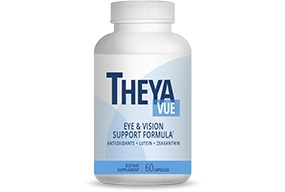
The TheyaVue panel is two thirds published, and the third that is not is named
Fourteen nutrients with figures, ten names sharing a line, and a serving size that is half the daily routine. Everything on this page comes off the bottle.
One bottle $59 · three bottles $147 · 60-day money-back guarantee
Order TheyaVue On The Official Website60 capsules a bottle · lot THE-26/GO-7323 · ships from the U.S.