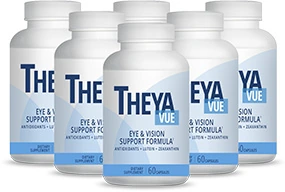
TheyaVue Official Website › How It Works
How It WorksHow TheyaVue Works: From Capsule to Macular Pigment
TheyaVue works by supplying carotenoids that the retina can store.
Lutein and zeaxanthin build the macular pigment, a yellow filter over the central retina that absorbs short-wavelength light and helps separate a target from its background.
For when to expect change, see the results timeline.
Three links in a chain. Two of them are well evidenced and the third is where an honest page has to slow down.
Link one: TheyaVue raises serum carotenoids
The first step is simply absorption, and it is not in doubt. A twelve-week trial gave 28 healthy adults one of three amounts of macular carotenoids or a placebo and drew blood every fortnight. Serum lutein and total zeaxanthin were significantly above placebo after two weeks at every level, which is fast, and they kept climbing.
Two things govern how much of a swallowed carotenoid gets that far. The first is the form it is in. The second, and the one a buyer controls, is fat: these are fat-soluble molecules and they need a lipid to travel with. A randomised crossover trial fed sixteen people the same carotenoid-rich salad with four different fats and measured what reached the plasma over the following ten hours. Bioaccessibility was 24.0 percent with olive oil against 14.9 percent with coconut oil, and higher again when the fat was emulsified. The avocado study found the same thing from whole food twenty years earlier.
The TheyaVue label asks for each capsule twenty to thirty minutes before a meal with a glass of water. It does not say anything about what is in the meal. That is the single most useful thing this desk can add to the directions, and it is on the how-to-use page as a step of its own.
Link two: the retina deposits what TheyaVue delivers
Macular pigment optical density is measurable, it varies several-fold between healthy people, and it responds to intake. The same twelve-week trial found it up significantly in all three treated groups against placebo, with the spatial profile of the pigment changing as well as its peak.
A six-month randomised trial in France did the same thing in a population closer to the one this product is aimed at: 120 people free of any retinal disease whose parents had neovascular macular degeneration. That is somebody worried about their eyes rather than somebody being treated for them.
Deposition is selective and it is slow relative to serum. Blood moves in a fortnight; pigment moves over months. That mismatch is the whole reason this product cannot do anything in week one, and it is why the seller's own three-second framing is the least defensible thing on its page.
Link three: what raised pigment does, and what TheyaVue cannot promise
This is where the chain gets interesting and where most pages in this category stop being careful.
A year-long, double-masked, placebo-controlled study in 59 healthy 18 to 25 year olds measured contrast sensitivity and lateral inhibition at baseline, six months and twelve months. Both improved in the treated groups and the size of the improvement tracked the size of the pigment change. A parallel trial at lutein 10 mg and zeaxanthin 2 mg for a year measured glare disability, photostress recovery and chromatic contrast. A third measured temporal contrast sensitivity, which is processing speed, and found it improved in young healthy subjects.
Notice what none of those outcomes is. Not one is a line gained on a letter chart. The chart measures resolution of high-contrast black letters in good light, and that is the one visual condition almost nobody complains about. Contrast, glare recovery and processing speed are what people actually notice going wrong, and they are what these trials move.
AREDS2 and the 2025 re-analysis of both AREDS trials are about slowing progression in people who already have macular degeneration. The Cochrane review on slowing progression and its companion on prevention are worth reading side by side, because they reach opposite-sounding conclusions for exactly that reason. Nothing on this website claims this bottle does what those formulas were tested to do, and the National Eye Institute is the right place to start for anyone who has been given that diagnosis.
What the rest of the TheyaVue formula is doing in the chain
| Group | Where it sits in the chain | How good the evidence is |
|---|---|---|
| Lutein, zeaxanthin | The whole chain: absorbed, deposited, and tied to measured outcomes | Strong, at amounts this label does not state |
| Bilberry, grape seed | A different mechanism: anthocyanins and proanthocyanidins acting on the ciliary muscle and on small vessels rather than on pigment | Two decent randomised trials each, at amounts this label does not state |
| Alpha lipoic acid, taurine, quercetin, rutin, lycopene | Antioxidant and cellular support, argued from mechanism | Thin in an eye. One large negative trial, two cell studies, one bioavailability study and one serum association between them |
| Eyebright | Tradition | One randomised trial, topical, in neonates, and it missed its primary outcome |
| Zinc, copper, vitamins C and E | The AREDS antioxidant and mineral core | Strong in diagnosed disease at higher amounts than this label carries |
| B vitamins, biotin, calcium, magnesium, selenium, chromium | General nutrition rather than eye-specific action | Not part of any tested eye formula at these levels |
Read down the last column rather than across the first. The number of names on a label and the amount of evidence behind them are different quantities.
A mechanistic review of the three carotenoids is a good single source on the biology of the first row, and the NCCIH summary on antioxidants is the corrective for anyone tempted to read the third row as more than it is.
Who publishes this TheyaVue website?
- Age-Related Eye Disease Study 2 (AREDS2) Research Group. Lutein + zeaxanthin and omega-3 fatty acids for age-related macular degeneration: the Age-Related Eye Disease Study 2 (AREDS2) randomized clinical trial. JAMA. 2013;309(19):2005-2015. PMID 23644932. https://pubmed.ncbi.nlm.nih.gov/23644932/
- Keenan TDL, Agron E, Keane PA, et al. Oral antioxidant and lutein/zeaxanthin supplements slow geographic atrophy progression to the fovea in age-related macular degeneration. Ophthalmology. 2025;132(1):14-29. PMID 39025435. https://pubmed.ncbi.nlm.nih.gov/39025435/
- Stringham JM, O'Brien KJ, Stringham NT. Contrast sensitivity and lateral inhibition are enhanced with macular carotenoid supplementation. Invest Ophthalmol Vis Sci. 2017;58(4):2291-2295. PMID 28431432. https://pubmed.ncbi.nlm.nih.gov/28431432/
- Stringham JM, Stringham NT. Serum and retinal responses to three different doses of macular carotenoids over 12 weeks of supplementation. Exp Eye Res. 2016;151:1-8. PMID 27426932. https://pubmed.ncbi.nlm.nih.gov/27426932/
- Hammond BR, Fletcher LM, Roos F, et al. A double-blind, placebo-controlled study on the effects of lutein and zeaxanthin on photostress recovery, glare disability, and chromatic contrast. Invest Ophthalmol Vis Sci. 2014;55(12):8583-8589. PMID 25468896. https://pubmed.ncbi.nlm.nih.gov/25468896/
- Bovier ER, Hammond BR. A randomized placebo-controlled study on the effects of lutein and zeaxanthin on visual processing speed in young healthy subjects. Arch Biochem Biophys. 2015;572:54-57. PMID 25483230. https://pubmed.ncbi.nlm.nih.gov/25483230/
- Korobelnik JF, Rougier MB, Delyfer MN, et al. Effect of dietary supplementation with lutein, zeaxanthin, and omega-3 on macular pigment: a randomized clinical trial. JAMA Ophthalmol. 2017;135(11):1259-1266. PMID 28973076. https://pubmed.ncbi.nlm.nih.gov/28973076/
- Johra FT, Bepari AK, Bristy AT, Reza HM. A mechanistic review of beta-carotene, lutein, and zeaxanthin in eye health and disease. Antioxidants (Basel). 2020;9(11):1046. PMID 33114699. https://pubmed.ncbi.nlm.nih.gov/33114699/
- Yao Y, Yang Z, Yin B, et al. Effects of dietary fat type and emulsification on carotenoid absorption: a randomized crossover trial. Am J Clin Nutr. 2023;117(5):1017-1025. PMID 36921903. https://pubmed.ncbi.nlm.nih.gov/36921903/
- Unlu NZ, Bohn T, Clinton SK, Schwartz SJ. Carotenoid absorption from salad and salsa by humans is enhanced by the addition of avocado or avocado oil. J Nutr. 2005;135(3):431-436. PMID 15735074. https://pubmed.ncbi.nlm.nih.gov/15735074/
- Evans JR, Lawrenson JG. Antioxidant vitamin and mineral supplements for slowing the progression of age-related macular degeneration. Cochrane Database Syst Rev. 2023;9(9):CD000254. PMID 37702300. https://pubmed.ncbi.nlm.nih.gov/37702300/
- Evans JR, Lawrenson JG. Antioxidant vitamin and mineral supplements for preventing age-related macular degeneration. Cochrane Database Syst Rev. 2017;7(7):CD000253. PMID 28756617. https://pubmed.ncbi.nlm.nih.gov/28756617/
- National Eye Institute. Age-Related Macular Degeneration (AMD). National Institutes of Health. https://www.nei.nih.gov/learn-about-eye-health/eye-conditions-and-diseases/age-related-macular-degeneration
- National Center for Complementary and Integrative Health. Antioxidants: In Depth. National Institutes of Health. https://www.nccih.nih.gov/health/antioxidants-in-depth
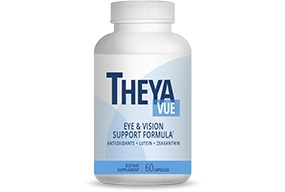
Give TheyaVue the run the evidence was built on
Serum moves in two weeks, pigment over months, and the measured visual outcomes at six months and a year. Three bottles is ninety days, which clears the shortest of those windows and still finishes a month inside the sixty-day guarantee.
One bottle $59 · three bottles $147 · 60-day money-back guarantee
Order TheyaVue On The Official Website60 capsules a bottle · lot THE-26/GO-7323 · ships from the U.S.