TheyaVue Official Website › Ingredients
IngredientsWhat Is in TheyaVue? Ingredients Listed One by One
TheyaVue lists 24 ingredients, and 14 of them have a set amount per capsule.
Those 14 run from 100 mg of vitamin C to 1.8 mcg of chromium. The other ten, including lutein and bilberry, share a 240.5 mg proprietary blend.
For the per-day figures, see the panel transcribed in full.
Two capsules a day is the routine, so every daily figure on this page is the panel figure doubled.
The two TheyaVue is sold on: lutein and zeaxanthin
Lutein
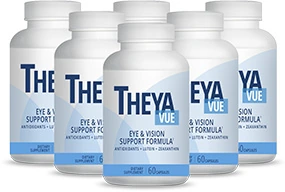
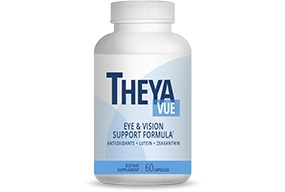
Tagetes erecta, usuallyIn the 240.5 mg blendA xanthophyll carotenoid the body cannot make. It arrives in food, principally dark leafy greens and egg yolk, circulates on lipoproteins and is taken up selectively by the central retina, where it forms most of the macular pigment. It is first on the blend list and first on the front of the bottle.
The evidence is the strongest in this category. AREDS2 gave 10 mg a day for five years to people who already had intermediate macular degeneration. A dose-ranging trial showed serum levels rising inside two weeks and macular pigment rising at every level tested. A year-long study in healthy young adults tied the pigment change to a measurable gain in contrast sensitivity.
Twelve milligrams of lutein and zeaxanthin together is what AREDS2 used. A 240.5 mg blend could hold that with room to spare, and whether it does is a figure only the manufacturer has.
Zeaxanthin
and its isomer meso-zeaxanthinIn the 240.5 mg blendLutein's partner. The two sit in different parts of the macula, zeaxanthin concentrated at the very centre where the cones are densest, and they are almost always studied together because separating them in a diet is close to impossible.
AREDS2 paired 2 mg of zeaxanthin with its 10 mg of lutein. The glare and photostress trial used the same pair for a year and measured how quickly vision recovers after an intense flash, which is the nearest published proxy for oncoming headlights. A separate randomised study measured visual processing speed in 69 young healthy subjects and found it improved.
It is fifth on this blend list, behind bilberry, alpha lipoic acid and eyebright, which says nothing about how much of it there is: a blend list is ordered by weight, so fifth means less than the four above it and more than the five below.
The other eight in the TheyaVue blend
Bilberry Extract
Vaccinium myrtillus, fruitIn the 240.5 mg blendA European relative of the blueberry, used for its anthocyanins. Second on the blend list, so by weight it is behind lutein and ahead of the other eight.
It has two decent modern trials. A twelve-week trial gave 240 mg a day to 109 adults aged 20 to 60 and measured ciliary muscle tone after screen work, finding it improved at weeks eight and twelve. An eight-week trial gave 480 mg a day to office workers using display terminals and measured critical flicker fusion, a fatigue marker, finding the load-induced drop reduced.
What it does not have is the night-vision effect the folklore attaches to it. A systematic review of twelve placebo-controlled trials found the four most recent randomised ones all negative, and noted that positive results clustered in the weaker designs. The broader review of anthocyanins in people is a fair summary of where the rest of the evidence sits.
Alpha Lipoic Acid
ALAIn the 240.5 mg blendA short-chain fatty acid that works as a cofactor in mitochondrial energy production and regenerates other antioxidants. Third on the blend list.
Its largest eye trial is a negative one. A two-year randomised trial gave 600 mg a day to 467 people with type 2 diabetes and measured whether it prevented clinically significant macular oedema; 26 of 235 developed it on the drug against 30 of 232 on placebo, a difference that was not significant. Printing that is more useful than not printing it.
The positive eye record is thinner. A six-month study in thirty people used a commercial formula containing R-lipoic acid alongside taurine, vitamins C and E, lutein, zeaxanthin, zinc, copper and DHA, and measured blood antioxidant status rather than vision. It is a case-control design, not a randomised trial. The 2025 review of everything ALA has been tried on is the place to see the whole picture.
One practical note: alpha lipoic acid can lower blood glucose. Anyone on a medication that already does should know that, and the amount here is unknown because it is inside the blend.
Eyebright
Euphrasia officinalis, herbIn the 240.5 mg blendA small European meadow plant named for the use it has been put to since the fourteenth century. Fourth on the blend list, so it is one of the larger components by weight.
The evidence is the thinnest on this label, and it is worth being exact. Its one modern randomised trial, an 84-neonate study in Bern, tested Euphrasia eye DROPS in preterm babies with ocular discharge and did not meet its primary outcome: 55.0 percent resolved on Euphrasia against 51.2 percent on saline placebo. That is a topical preparation in newborns, which has no bearing on an oral capsule in an adult.
Beyond that there is laboratory work: an in vitro study of eyebright extract against human corneal cells. Cells in a dish are where a hypothesis starts, not where it finishes. Eyebright is on this label for tradition and for its name, and this desk says so rather than dressing it up.
Quercetin
Sophora japonica, budIn the 240.5 mg blendA flavonol, here sourced from Japanese pagoda tree buds, which are one of the richest commercial sources of it.
There is no human eye trial of quercetin to cite. What exists is mechanistic: work in retinal pigment epithelium cells and in mice found it protected the outer retinal barrier from oxidative injury by promoting autophagy. That is a reason to be interested and not a reason to expect anything.
Rutin
Sophora japonica, flowerIn the 240.5 mg blendQuercetin with a sugar attached, from the flowers of the same tree. It has a long history in vascular formulas on the argument that it supports capillary integrity.
A human supplementation study measured what happens to rutin after it is swallowed and how much antioxidant effect survives the trip. It is a bioavailability paper rather than an eye paper, and there is no eye paper to put in its place.
L-Taurine
In the 240.5 mg blendAn amino sulfonic acid, and one of the most abundant free amino acids in the retina. That is the reason it appears on eye formulas.
A review of the retinal case for taurine sets out what is known: taurine depletion causes photoreceptor degeneration in animals, and people with mutations in the taurine transporter develop early retinal degeneration. Neither of those says that adding taurine to a well-nourished adult does anything, and no trial has shown that it does.
Grape Seed Extract
Vitis vinifera, seedIn the 240.5 mg blendTaken for its proanthocyanidins, the same family of compounds bilberry is taken for.
Its best eye evidence is a twelve-month randomised trial in 124 people with non-proliferative diabetic retinopathy, given 150 mg a day against placebo and against a licensed comparator. Hard exudate severity improved more on the extract than on either. It is a real trial in a real eye condition, and the population is a long way from a healthy adult taking a general supplement.
Lycopene
In the 240.5 mg blendThe red carotenoid in tomatoes. Last on the blend list, so by weight it is the smallest of the ten.
Unlike lutein and zeaxanthin it is not deposited in the macula in any quantity. A serum study found lycopene lower in people with macular degeneration while lutein and zeaxanthin were not, and a population study of serum carotenoids found a broadly similar pattern. Those are associations in blood, not trials of a capsule, and the distinction matters.
The fourteen TheyaVue nutrients that carry a figure
| Nutrient | Per capsule | Percent DV, per capsule | Per day, at two capsules |
|---|---|---|---|
| Vitamin A (as Beta-carotene) | 50 mcg RAE | 5% | 100 mcg RAE |
| Vitamin C (as Ascorbic Acid) | 100 mg | 111% | 200 mg |
| Calcium (as Calcium carbonate) | 25 mg | 2% | 50 mg |
| Vitamin E (DL-Alpha tocopherol acetate) | 10 mg | 66% | 20 mg |
| Vitamin B1 (as Thiamine mononitrate) | 4 mg | 333% | 8 mg |
| Vitamin B2 (as Riboflavin) | 4 mg | 307% | 8 mg |
| Vitamin B3 (as Niacin) | 20 mg NE | 125% | 40 mg NE |
| Vitamin B12 (as Cyanocobalamin) | 13.5 mcg | 562% | 27 mcg |
| Biotin | 400 mcg | 1,333% | 800 mcg |
| Magnesium (as Magnesium oxide) | 20 mg | 5% | 40 mg |
| Zinc (as Zinc oxide) | 16 mg | 145% | 32 mg |
| Selenium (as Selenium AAC) | 4 mcg | 7% | 8 mcg |
| Copper (as Copper gluconate) | 1 mg | 111% | 2 mg |
| Chromium (as Chromium picolinate) | 1.8 mcg | 5% | 3.6 mcg |
Transcribed from the panel photographed on the bottle. The first two columns are the label's own and are written per capsule; the last column is the same figure doubled, because the directions are two capsules a day.
Four of those fourteen are the antioxidant and mineral core of the AREDS formula: vitamin C, vitamin E, zinc and copper. Two capsules give 200 mg, 20 mg, 32 mg and 2 mg against the trial figures of 500 mg, 400 IU, 80 mg and 2 mg. The copper matches exactly. The zinc sits above the 25 mg arm AREDS2 tested and well below its 80 mg one. The two vitamins are a fraction of the trial amounts.
Vitamin A appears as beta carotene at 50 mcg RAE a capsule. That is the only carotenoid on this label with a number against it and it is a small one, which in this instance is a good thing: beta carotene is the ingredient the modern AREDS formula removed, and the Institute of Medicine advises against supplemental beta carotene for the general population.
The B vitamins, biotin, calcium, magnesium, selenium and chromium are formulation rather than dose. Biotin at 400 mcg a capsule reads as 1,333 percent of a daily value, which sounds enormous and is not: biotin is cheap, water-soluble and harmless at that level. Its one practical consequence is in a laboratory, and the side effects page covers it.
What else is in a TheyaVue capsule
The other-ingredients line is four items long: Cellulose (Vegetable Capsule), Rice Flour, Magnesium Stearate, Silicon Dioxide.
- Cellulose (Vegetable Capsule) is the shell. It is what makes the vegetarian mark on the pack checkable rather than decorative, because a gelatin shell would contradict it.
- Rice Flour is the bulking agent that fills the rest of the capsule. It is also why the gluten-free mark holds up.
- Magnesium Stearate is a flow agent, present in a fraction of a milligram, and it stops powder sticking to the machinery that fills the capsules.
- Silicon Dioxide is an anti-caking agent doing the same sort of job.
Not much on its own, but it is four items rather than fourteen, there are no artificial colours in it, and every one of the four is doing a mechanical job rather than a marketing one. A capsule shell, a filler and two flow agents is about as plain as this part of a label gets.
Honest label analysis: what the TheyaVue panel does not tell you
Three gaps, stated once and then left alone.
- The blend split. Ten names share 240.5 mg. Each of them is somewhere between a trace and the whole of it, and the order of the list is the only clue: it runs by descending weight, so lutein is the largest and lycopene the smallest. Nothing else can be read off it and nothing here estimates a number.
- The lutein source and form. Lutein is sold as free lutein or as lutein esters, which are absorbed differently and are dosed differently as a result. The panel says neither.
- Standardisation of the botanicals. Bilberry trials use extract standardised to a stated anthocyanin percentage. Grape seed trials use extract standardised to proanthocyanidins. This panel names the plant, the part and the Latin binomial for each, which is more than many, and no standardisation figure.
None of those three is unusual in this category and all three are worth knowing before comparing this bottle with another. The buying guide turns them into four questions to ask of any eye formula.
Who publishes this TheyaVue website?
- Age-Related Eye Disease Study 2 (AREDS2) Research Group. Lutein + zeaxanthin and omega-3 fatty acids for age-related macular degeneration: the Age-Related Eye Disease Study 2 (AREDS2) randomized clinical trial. JAMA. 2013;309(19):2005-2015. PMID 23644932. https://pubmed.ncbi.nlm.nih.gov/23644932/
- Stringham JM, O'Brien KJ, Stringham NT. Contrast sensitivity and lateral inhibition are enhanced with macular carotenoid supplementation. Invest Ophthalmol Vis Sci. 2017;58(4):2291-2295. PMID 28431432. https://pubmed.ncbi.nlm.nih.gov/28431432/
- Stringham JM, Stringham NT. Serum and retinal responses to three different doses of macular carotenoids over 12 weeks of supplementation. Exp Eye Res. 2016;151:1-8. PMID 27426932. https://pubmed.ncbi.nlm.nih.gov/27426932/
- Hammond BR, Fletcher LM, Roos F, et al. A double-blind, placebo-controlled study on the effects of lutein and zeaxanthin on photostress recovery, glare disability, and chromatic contrast. Invest Ophthalmol Vis Sci. 2014;55(12):8583-8589. PMID 25468896. https://pubmed.ncbi.nlm.nih.gov/25468896/
- Bovier ER, Hammond BR. A randomized placebo-controlled study on the effects of lutein and zeaxanthin on visual processing speed in young healthy subjects. Arch Biochem Biophys. 2015;572:54-57. PMID 25483230. https://pubmed.ncbi.nlm.nih.gov/25483230/
- Kosehira M, Machida N, Kitaichi N. A 12-week-long intake of bilberry extract (Vaccinium myrtillus L.) improved objective findings of ciliary muscle contraction of the eye: a randomized, double-blind, placebo-controlled, parallel-group comparison trial. Nutrients. 2020;12(3):600. PMID 32106548. https://pubmed.ncbi.nlm.nih.gov/32106548/
- Ozawa Y, Kawashima M, Inoue S, et al. Bilberry extract supplementation for preventing eye fatigue in video display terminal workers. J Nutr Health Aging. 2015;19(5):548-554. PMID 25923485. https://pubmed.ncbi.nlm.nih.gov/25923485/
- Canter PH, Ernst E. Anthocyanosides of Vaccinium myrtillus (bilberry) for night vision - a systematic review of placebo-controlled trials. Surv Ophthalmol. 2004;49(1):38-50. PMID 14711439. https://pubmed.ncbi.nlm.nih.gov/14711439/
- Goncalves AC, Nunes AR, Falcao A, Alves G, Silva LR. Dietary effects of anthocyanins in human health: a comprehensive review. Pharmaceuticals (Basel). 2021;14(7):690. PMID 34358116. https://pubmed.ncbi.nlm.nih.gov/34358116/
- Haritoglou C, Gerss J, Hammes HP, et al. Alpha-lipoic acid for the prevention of diabetic macular edema. Ophthalmologica. 2011;226(3):127-137. PMID 21811051. https://pubmed.ncbi.nlm.nih.gov/21811051/
- Sanz-Gonzalez SM, Raga-Cervera J, Aguirre Lipperheide M, et al. Effect of an oral supplementation with a formula containing R-lipoic acid in glaucoma patients. Arch Soc Esp Oftalmol (Engl Ed). 2020;95(3):120-129. PMID 31980324. https://pubmed.ncbi.nlm.nih.gov/31980324/
- Carnib BL, Souza EV, Floresta LRS, et al. Therapeutic applications of alpha-lipoic acid: a review of clinical and preclinical evidence (1998-2024). Biomed Pharmacother. 2025;191:118480. PMID 40834747. https://pubmed.ncbi.nlm.nih.gov/40834747/
- Meier-Girard D, Gerstenberg G, Stoffel L, et al. Euphrasia eye drops in preterm neonates with ocular discharge: a randomized double-blind placebo-controlled trial. Front Pediatr. 2020;8:449. PMID 32850558. https://pubmed.ncbi.nlm.nih.gov/32850558/
- Paduch R, Wozniak A, Niedziela P, Rejdak R. Assessment of eyebright (Euphrasia officinalis L.) extract activity in relation to human corneal cells using in vitro tests. Balkan Med J. 2014;31(1):29-36. PMID 25207164. https://pubmed.ncbi.nlm.nih.gov/25207164/
- Li DL, Mao L, Gu Q, Wei F, Gong YY. Quercetin protects retina external barrier from oxidative stress injury by promoting autophagy. Cutan Ocul Toxicol. 2021;40(1):7-13. PMID 33283549. https://pubmed.ncbi.nlm.nih.gov/33283549/
- Boyle SP, Dobson VL, Duthie SJ, Hinselwood DC, Kyle JA, Collins AR. Bioavailability and efficiency of rutin as an antioxidant: a human supplementation study. Eur J Clin Nutr. 2000;54(10):774-782. PMID 11083486. https://pubmed.ncbi.nlm.nih.gov/11083486/
- Garcia-Ayuso D, Di Pierdomenico J, Martinez-Vacas A, et al. Taurine: a promising nutraceutic in the prevention of retinal degeneration. Neural Regen Res. 2024;19(3):606-610. PMID 37721291. https://pubmed.ncbi.nlm.nih.gov/37721291/
- Moon SW, Shin YU, Cho H, et al. Effect of grape seed proanthocyanidin extract on hard exudates in patients with non-proliferative diabetic retinopathy. Medicine (Baltimore). 2019;98(21):e15515. PMID 31124931. https://pubmed.ncbi.nlm.nih.gov/31124931/
- Cardinault N, Abalain JH, Sairafi B, et al. Lycopene but not lutein nor zeaxanthin decreases in serum and lipoproteins in age-related macular degeneration patients. Clin Chim Acta. 2005;357(1):34-42. PMID 15963792. https://pubmed.ncbi.nlm.nih.gov/15963792/
- Zhou H, Zhao X, Johnson EJ, et al. Serum carotenoids and risk of age-related macular degeneration in a Chinese population sample. Invest Ophthalmol Vis Sci. 2011;52(7):4338-4344. PMID 21508112. https://pubmed.ncbi.nlm.nih.gov/21508112/
- Age-Related Eye Disease Study Research Group. A randomized, placebo-controlled, clinical trial of high-dose supplementation with vitamins C and E, beta carotene, and zinc for age-related macular degeneration and vision loss: AREDS report no. 8. Arch Ophthalmol. 2001;119(10):1417-1436. PMID 11594942. https://pubmed.ncbi.nlm.nih.gov/11594942/
- Institute of Medicine (US) Panel on Dietary Antioxidants and Related Compounds. Beta-Carotene and Other Carotenoids. In: Dietary Reference Intakes for Vitamin C, Vitamin E, Selenium, and Carotenoids. Washington DC: National Academies Press; 2000. https://www.ncbi.nlm.nih.gov/books/NBK225469/
Read the TheyaVue panel first, then decide
Twenty-four names, fourteen with figures and ten sharing a line. If the fourteen are what you are buying, the panel is unusually open for this category. If the ten are what you are buying, the blend total is the only number you will get.
One bottle $59 · three bottles $147 · 60-day money-back guarantee
Order TheyaVue On The Official Website60 capsules a bottle · lot THE-26/GO-7323 · ships from the U.S.