TheyaVue Official Website › Choosing An Eye Supplement
Choosing An Eye SupplementChoosing An Eye Supplement: Eight Questions For Any Label
Eight questions, each answerable from a label in about a minute. They are the ones that separate a formula you can evaluate from a formula you have to trust, and they work on any bottle in this category including the one this desk sells. The first two matter more than the other six put together: what the serving size is, and whether the ingredients you are buying have their own numbers.
Answer them on two bottles side by side and the comparison usually makes itself.
One: what is a serving, and how many servings is a dose?
Read the top of the Supplement Facts panel before anything else. Serving size and servings per container are the two lines that make every other number on the panel mean something, and they are the two people skip.
A panel written per one capsule on a product taken twice a day reports half the daily amount in every row, including the percent daily value column. That is not a trick, it is the standard format, and it is why two bottles can look completely different and deliver the same thing.
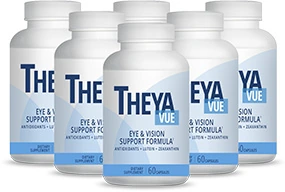
TheyaVue is an example, and this desk prints both columns on its label page for that reason: serving size one capsule, directions two capsules, so zinc reads 16 mg on the bottle and is 32 mg in a day.
Do the multiplication first. Then compare.
Two: does the ingredient you are buying have its own number?
A proprietary blend is a legal, common and perfectly respectable way to declare a mixture. The total has to be stated and the components have to be listed in descending order by weight, and that is all the information it gives.
What it costs you is the only comparison that matters in this category. Lutein and zeaxanthin became eye ingredients through one trial at 10 mg and 2 mg a day. If a label tells you it contains lutein but not how much, that trial is not evidence about the bottle in your hand, and neither is any other.
Two useful things can still be read off a blend line. The order is by weight, so the first name is the largest. And the total is a ceiling, so a 50 mg blend containing lutein cannot be delivering a 10 mg trial dose alongside eight other ingredients, whatever the advertising says. A 240 mg blend could be. That is a real distinction and it is worth doing the arithmetic for.
Three: is the evidence for this ingredient in an eye, in a person, at this amount?
Three separate hurdles, and most ingredients in this category clear one or two.
| Hurdle | What clears it | What does not |
|---|---|---|
| In an eye | A trial with an ocular outcome: macular pigment, contrast, glare, ciliary muscle tone, disease progression. | A trial of the same ingredient measuring blood antioxidant status, or inflammation, or anything systemic. |
| In a person | A randomised controlled trial in humans. | Cell culture, mice, or a mechanism paper. Those are where a hypothesis starts. |
| At this amount | The trial dose and the label amount are the same order of magnitude. | A trial at 600 mg quoted for a label that gives no figure, or one that gives a tenth of it. |
An ingredient that clears all three is rare. One that clears none is tradition, and tradition on a label is not a defect as long as it is not sold as science.
Two worked examples from a label this desk knows well. Bilberry clears all three hurdles in principle: a twelve-week trial at 240 mg a day with an ocular outcome in adults. Whether a particular bottle clears the third depends on whether it prints a number.
Eyebright clears none. Its one modern randomised trial is a topical eye drop in preterm neonates and it did not meet its primary outcome. It is on eye formulas because it is called eyebright, and a label that names it is telling you about its heritage rather than its evidence.
Four: what does a day of it cost, and what does a decision cost?
Divide the pack price by the number of days it covers at the stated routine. Not by the number of capsules, and not by the number of bottles.
Then ask the second question, which almost nobody asks: how much does it cost to find out whether this suits me? A ladder that starts at six bottles makes a trial run expensive, and a seller who flags the largest pack is optimising their revenue rather than your decision.
Set the guarantee against the pack size while you are there. A sixty-day window covers two bottles of a twice-daily product. Anything beyond that is stock you are keeping whatever happens.
Five: what does the marketing promise that the label does not?


Read the front panel, then read the advertising, then list the differences. On a well-behaved product the list is short and the advertising is a louder version of the label. On a badly-behaved one the advertising contains a promise, a timescale or a number that appears nowhere on the bottle.
The FTC guidance on health products is the standard those claims are supposed to meet, and reading a few pages of it changes how a sales page reads permanently. The short version: a claim needs competent and reliable scientific evidence, the evidence has to match the claim, and a testimonial is not evidence.
Where this desk's own product is concerned, the four claims on its seller's video that do not travel are named on the benefits page rather than left out.
Six: what is the zinc, and is there copper with it?
The one safety question in this category that a label can actually answer.
Zinc is in most eye formulas because the AREDS trial used 80 mg of it, paired deliberately with 2 mg of copper. The pairing is the important half: sustained zinc without copper depletes copper over months, and the case reports describe anaemia and neurological signs rather than anything acute.
So read two lines. The zinc figure, doubled if the serving size says to, against the 40 mg upper intake level the Institute of Medicine sets. And whether copper appears at all. A formula naming zinc and no copper is a question worth putting to a seller before buying it.
Then add up every other bottle in the cupboard, because the upper level is a total from all sources and nobody checks.
Seven: what form is the vitamin A, and does that matter to you?
Eye formulas carry vitamin A as retinol, as beta carotene, or not at all, and the three are genuinely different propositions.
Retinol has a well-defined upper intake level because it accumulates. Beta carotene has no upper level and no recommended allowance, and its issue is narrower and specific: CARET and ATBC found excess lung cancer in smokers given 20 to 30 mg a day, and that is why the modern AREDS formula contains none.
For a person who has never smoked, at the amounts on an ordinary label, this is mostly an academic question. For a current or former smoker it is not, and the arithmetic is the whole of the answer: a label giving a fraction of a milligram is not the same exposure as a trial giving twenty. MedlinePlus and the Institute of Medicine chapter are the two places to check what a figure means.
Eight: what does the seal actually certify, and who issues it?
Seals on a supplement pack fall into three groups and they look identical.
- Third-party certification. A named certifier, an auditable standard and usually a certificate number. These are worth something.
- Manufacturer declarations. Made in the USA, non-GMO, all natural. These are the manufacturer's own word, which is not worthless and is not certification.
- Statements about the factory rather than the product. An FDA-registered facility mark is the commonest, and it is the one most often read as approval. No dietary supplement is approved by the Food and Drug Administration.
The quick test is to look for a name. A seal with a certifier on it can be checked. A seal with no name on it is a graphic, and a seal reading physician formulated with no clinician named anywhere is the clearest example of the category.
Two marks on any pack usually can be checked against the label itself: gluten free and vegetarian, both of which the other-ingredients line either supports or contradicts. This desk does that exercise on its own product's ten marks on the testing and quality page.
Who publishes this TheyaVue website?
- Kosehira M, Machida N, Kitaichi N. A 12-week-long intake of bilberry extract (Vaccinium myrtillus L.) improved objective findings of ciliary muscle contraction of the eye: a randomized, double-blind, placebo-controlled, parallel-group comparison trial. Nutrients. 2020;12(3):600. PMID 32106548. https://pubmed.ncbi.nlm.nih.gov/32106548/
- Meier-Girard D, Gerstenberg G, Stoffel L, et al. Euphrasia eye drops in preterm neonates with ocular discharge: a randomized double-blind placebo-controlled trial. Front Pediatr. 2020;8:449. PMID 32850558. https://pubmed.ncbi.nlm.nih.gov/32850558/
- Age-Related Eye Disease Study Research Group. A randomized, placebo-controlled, clinical trial of high-dose supplementation with vitamins C and E, beta carotene, and zinc for age-related macular degeneration and vision loss: AREDS report no. 8. Arch Ophthalmol. 2001;119(10):1417-1436. PMID 11594942. https://pubmed.ncbi.nlm.nih.gov/11594942/
- Magham K, Han J, Eilbert W. Severe copper deficiency anemia caused by zinc supplement use. Am J Emerg Med. 2023;72:222.e1-222.e2. PMID 37640593. https://pubmed.ncbi.nlm.nih.gov/37640593/
- Institute of Medicine (US) Panel on Micronutrients. Zinc. In: Dietary Reference Intakes for Vitamin A, Vitamin K, Arsenic, Boron, Chromium, Copper, Iodine, Iron, Manganese, Molybdenum, Nickel, Silicon, Vanadium, and Zinc. Washington DC: National Academies Press; 2001. https://www.ncbi.nlm.nih.gov/books/NBK222317/
- Institute of Medicine (US) Panel on Micronutrients. Vitamin A. In: Dietary Reference Intakes for Vitamin A, Vitamin K, Arsenic, Boron, Chromium, Copper, Iodine, Iron, Manganese, Molybdenum, Nickel, Silicon, Vanadium, and Zinc. Washington DC: National Academies Press; 2001. https://www.ncbi.nlm.nih.gov/books/NBK222318/
- Omenn GS, Goodman GE, Thornquist MD, et al. Effects of a combination of beta carotene and vitamin A on lung cancer and cardiovascular disease. N Engl J Med. 1996;334(18):1150-1155. PMID 8602180. https://pubmed.ncbi.nlm.nih.gov/8602180/
- The Alpha-Tocopherol, Beta Carotene Cancer Prevention Study Group. The effect of vitamin E and beta carotene on the incidence of lung cancer and other cancers in male smokers. N Engl J Med. 1994;330(15):1029-1035. PMID 8127329. https://pubmed.ncbi.nlm.nih.gov/8127329/
- MedlinePlus. Vitamin A. U.S. National Library of Medicine. https://medlineplus.gov/ency/article/002400.htm
- Federal Trade Commission. Health Products Compliance Guidance. December 2022. https://www.ftc.gov/business-guidance/resources/health-products-compliance-guidance
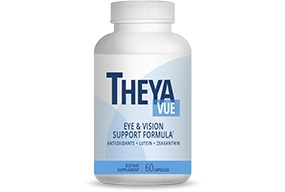
Run these eight questions on TheyaVue as well as on everything else
Serving size one capsule with a two-capsule routine, fourteen nutrients with figures, ten in a blend, zinc paired with copper at the trial amount, and ten marks of which three check out.
One bottle $59 · three bottles $147 · 60-day money-back guarantee
Order TheyaVue On The Official Website60 capsules a bottle · lot THE-26/GO-7323 · ships from the U.S.