TheyaVue Official Website › Blog › What A 240.5 mg Blend Can Hold
What A 240.5 Milligram Blend Can Hold, And What It Cannot
A proprietary blend gives you one number for several ingredients, and most readers treat that as no information at all. It is not. A total is a ceiling, the list is ordered by weight, and between those two facts you can usually work out whether the amount being advertised could possibly be in there. Sometimes the answer is a flat no.
What a proprietary blend actually declares
A proprietary blend is a permitted way to declare a mixture on a Supplement Facts panel. Two requirements attach to it. The total weight of the blend has to be stated. And the ingredients within it have to be listed in descending order by weight.
That is all. The individual amounts do not have to be declared, and the reason the format exists is competitive: a formulator who publishes every figure has published a recipe anyone can copy.
Whether that protection is worth what it costs a reader is a fair argument and it is not the argument this article is having. The useful question is narrower. Given a total and an order, what can actually be worked out?
| What a blend line gives you | What it withholds | What you can still work out |
|---|---|---|
| A total weight | The split | A ceiling for every component |
| The order, by descending weight | The gaps between them | Which ingredient is largest and which is smallest |
| The full list of names | Which are present at a meaningful amount | Whether any single trial amount could fit at all |
| A legal declaration | A comparable figure | Whether the marketing is claiming more than the total allows |
Four rows. The right-hand column is the part most readers give up on, and it is the part that does the work.
The total is a ceiling, and a ceiling is useful
No ingredient inside a blend can weigh more than the blend. That sounds trivial and it is the most powerful thing on the line, because the trial amounts in this category are public and some of them are large.
Take a concrete case. The twelve-week bilberry trial that measured ciliary-muscle function after screen work used 240 mg a day of standardised extract. The eight-week trial in display-terminal workers used 480 mg a day. If a label puts bilberry inside a 100 mg blend with five other names, neither of those amounts is in the bottle. That is not a suspicion, it is arithmetic, and it can be done from the panel alone.
Run the same test upward and the conclusion can be reassuring. AREDS2 used 10 mg of lutein and 2 mg of zeaxanthin. Twelve milligrams inside a 240.5 mg blend is five percent of it, which is comfortably possible alongside eight other ingredients. A ceiling that clears the trial amount does not prove the amount is there. It does remove the reason to assume it is not.
The order is by weight, and that is useful too
The list is not alphabetical and it is not the order the marketing prefers. It runs from the heaviest component to the lightest, and that ordering is a requirement rather than a courtesy.
So the first name on a blend list is the largest single thing in it, and the last name is the smallest. On a ten-name blend that makes the tenth ingredient something the formulator chose to include at the smallest weight of the ten, which is a reasonable thing to know before paying for it.
It also lets you catch a particular kind of overselling. When the ingredient a product is advertised on sits eighth out of ten, the advertising and the panel disagree about what the product is.
The arithmetic on one real blend
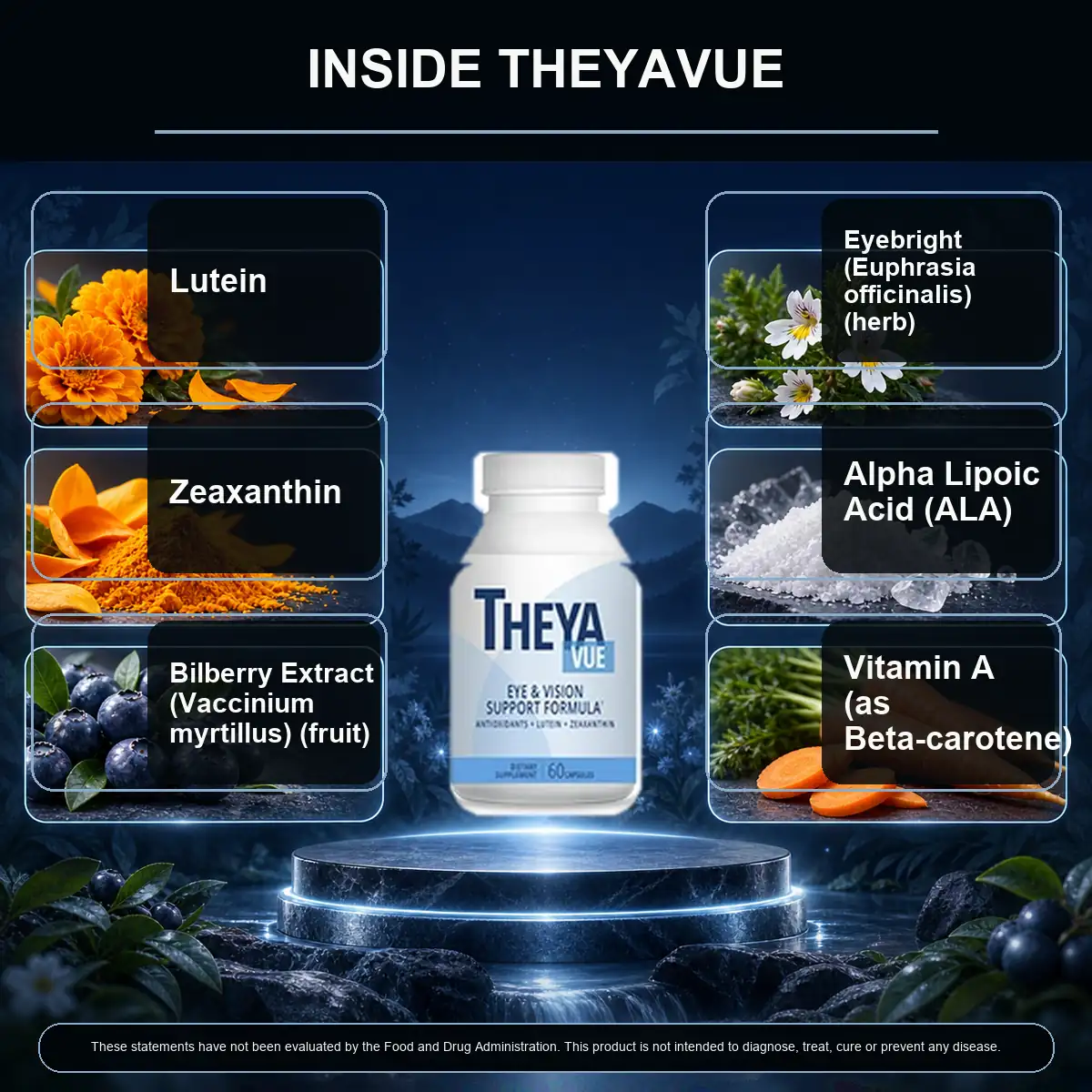
The label this desk sells declares a blend of 240.5 mg covering ten names, in this order: lutein, bilberry extract, alpha lipoic acid, eyebright, zeaxanthin, quercetin, rutin, taurine, grape seed extract and lycopene.
That is a large blend by the standards of the category, and a crowded one. Ten names is more than most, which cuts both ways: more of the total is spoken for, and the total is bigger than most to start with.
| Ingredient | Trial amount | As a share of a 240.5 mg blend |
|---|---|---|
| Lutein | 10 mg a day (AREDS2) | 4 percent |
| Zeaxanthin | 2 mg a day (AREDS2) | under 1 percent |
| Bilberry extract | 240 mg a day (12-week trial) | 100 percent, on its own |
| Bilberry extract | 480 mg a day (8-week trial) | 200 percent, impossible |
| Alpha lipoic acid | 600 mg a day (2-year trial) | 249 percent, impossible |
| Grape seed extract | 150 mg a day (12-month trial) | 62 percent |
Six trial amounts against one blend total. Two of the six cannot fit at trial strength no matter how the blend is divided, and that is a fact about arithmetic rather than an accusation about a product.
Read the right-hand column rather than the middle one. Lutein at trial strength would use four percent of the blend. Zeaxanthin would use under one percent. Both of those fit easily, so the two ingredients the product is advertised on are arithmetically capable of being present at the amounts the trials used.
Bilberry at the lower of its two trial amounts would use the entire blend on its own, and at the higher amount it would need twice the blend. Alpha lipoic acid at the amount used in its largest eye trial would need two and a half times it. Grape seed at its trial amount would take sixty-two percent.
So three of the six are ruled out at trial strength by the total alone, and this is worth stating carefully because it is not a criticism of the formulation. A botanical present below its trial amount may still be doing something. It is simply not doing the thing the trial measured, and a page that cites the trial without mentioning the arithmetic is borrowing evidence that does not apply.
- The two lead carotenoids could be present at full trial strength and still leave ninety-five percent of the blend for everything else.
- The two botanicals with the largest trial amounts cannot be at trial strength, because their trials used more than the whole blend.
- Lutein is first on the list, so it is the largest single component.
- Lycopene is last, so it is the smallest.
- None of that tells you the actual split, and nothing on this website estimates it.
TheyaVue prints the blend total, and this desk prints the arithmetic
Ten names, one line, and a table on the ingredients page that puts every trial amount beside the ceiling it has to fit inside. The two the product is sold on fit. Two of the others do not.
Three bottles $147 · six bottles $234 · 60-day money-back guarantee
Order TheyaVue On The Official Website60 capsules a bottle · lot THE-26/GO-7323 · ships from the U.S.
When the answer is a flat no
The most useful thing this arithmetic does is rule things out, and the smaller the blend the more it rules out.
A 50 mg blend containing lutein cannot be delivering 10 mg of it alongside eight other ingredients unless lutein is twenty percent of the blend, which would be unusual and would make everything else a trace. A 25 mg blend naming a botanical whose trials used 300 mg is not delivering a trial amount of anything, and no wording on the front of the bottle changes that.
The reverse case is the one to watch for in marketing. A large blend is often presented as evidence of generosity, and it is evidence of exactly one thing: room. The dose-ranging carotenoid study tested three levels of macular carotenoid, 7.44, 13.13 and 27.03 mg a day, and found serum and pigment responses at all three. A blend with room for any of those is a blend with room. It is not a blend with a dose in it.
Four questions a blend line can still answer
- Could the headline ingredient be at trial strength? Compare the trial amount with the blend total. If the trial amount is a large fraction of the total, the answer is probably not.
- Where does the headline ingredient sit in the order? First is the best case. Eighth of ten, on a product named after it, is a question for the seller.
- How many names share the total? Ten names in 240 mg is an average of 24 mg each. Four names in 240 mg is an average of 60. The average is not the split, but it moves the plausible range a long way.
- Does any single trial amount exceed the whole blend? If so, every citation of that trial on that product's pages is borrowing evidence the bottle cannot support.
What is fair to say about a blend, and what is not
- Fair: the total, the order, the names, and any ceiling that follows from them.
- Fair: that a blend protects a formula from being copied, which is a real commercial reason and not a dishonest one.
- Fair: that the reader cannot compare an individual ingredient with its trial, and that in this category the amount is most of the evidence.
- Not fair: estimating a split. Nobody outside the manufacturer has the figure and an estimate dressed as a number is worse than a gap.
- Not fair: treating a blend as automatic evidence of underdosing. Plenty of blends are generous and none of them can prove it.
- Not fair: citing a trial amount for an ingredient whose label gives no figure, without saying that the two cannot be set against each other.
The bottom line
A proprietary blend is less opaque than it looks and less informative than a printed figure. It gives a ceiling and an order, and those two together answer more questions than most readers ask of them.
On the blend in front of this desk, the arithmetic says the two ingredients the product leads on could be there at the amounts their trial used, and that two of the botanicals cannot be at theirs. Both halves of that belong on the page, and the second half is the reason this article exists.
Do the sum before you buy. It takes a calculator and the trial amount, and the trial amount is on the ingredients page of any site worth reading.
This is a dietary supplement website and this article is product information. Nothing here treats, prevents or manages macular degeneration, cataract, glaucoma or any diagnosed eye condition, and nothing here replaces an eye examination. Sight that has changed is a reason to book one.
References
- Age-Related Eye Disease Study 2 (AREDS2) Research Group. Lutein + zeaxanthin and omega-3 fatty acids for age-related macular degeneration: the Age-Related Eye Disease Study 2 (AREDS2) randomized clinical trial. JAMA. 2013;309(19):2005-2015. PMID 23644932. https://pubmed.ncbi.nlm.nih.gov/23644932/
- Kosehira M, Machida N, Kitaichi N. A 12-week-long intake of bilberry extract (Vaccinium myrtillus L.) improved objective findings of ciliary muscle contraction of the eye: a randomized, double-blind, placebo-controlled, parallel-group comparison trial. Nutrients. 2020;12(3):600. PMID 32106548. https://pubmed.ncbi.nlm.nih.gov/32106548/
- Ozawa Y, Kawashima M, Inoue S, et al. Bilberry extract supplementation for preventing eye fatigue in video display terminal workers. J Nutr Health Aging. 2015;19(5):548-554. PMID 25923485. https://pubmed.ncbi.nlm.nih.gov/25923485/
- Moon SW, Shin YU, Cho H, et al. Effect of grape seed proanthocyanidin extract on hard exudates in patients with non-proliferative diabetic retinopathy. Medicine (Baltimore). 2019;98(21):e15515. PMID 31124931. https://pubmed.ncbi.nlm.nih.gov/31124931/
- Stringham JM, Stringham NT. Serum and retinal responses to three different doses of macular carotenoids over 12 weeks of supplementation. Exp Eye Res. 2016;151:1-8. PMID 27426932. https://pubmed.ncbi.nlm.nih.gov/27426932/
- Haritoglou C, Gerss J, Hammes HP, et al. Alpha-lipoic acid for the prevention of diabetic macular edema. Ophthalmologica. 2011;226(3):127-137. PMID 21811051. https://pubmed.ncbi.nlm.nih.gov/21811051/