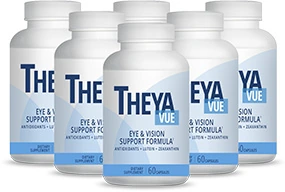
TheyaVue Official Website › Blog › Serving Size One Capsule, Directions Two
Serving Size One Capsule, Directions Two: The Arithmetic Every Panel Hides
A Supplement Facts panel is written per serving, and a serving is whatever the manufacturer says it is. When the serving is one capsule and the directions are two, every number on the panel is half of what you actually take, including the percent daily value column that looks alarming enough already. It is legal, it is standard, and almost nobody does the multiplication.
The two lines that govern every other number
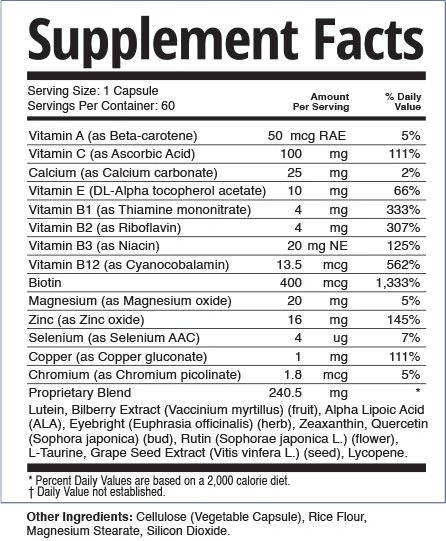
At the top of every Supplement Facts panel, above the nutrients, sit two lines: serving size, and servings per container. They are set in smaller type than the product name and larger type than anything beneath them, and they are the two lines that decide what every figure below them means.
A serving is not a dose. It is a unit of declaration, chosen by the manufacturer, and it can be one capsule, two capsules, a scoop, a sachet or half a bottle. The rules require the panel to be consistent with it and they do not require it to match the directions.
So a label can quite properly declare a panel per one capsule and then, in a different block of text on a different part of the bottle, instruct you to take two. Both statements are true. Neither is misleading on its own. The product of the two is a daily intake that appears nowhere on the packaging.
| What the panel says | What the directions say | What a day is |
|---|---|---|
| Serving Size: 1 Capsule | One capsule twice daily | Two servings |
| Servings Per Container: 60 | Two a day | Thirty days a bottle |
| Zinc 16 mg, 145 percent | Two capsules | 32 mg, 290 percent |
| Biotin 400 mcg, 1,333 percent | Two capsules | 800 mcg, 2,666 percent |
| Vitamin C 100 mg, 111 percent | Two capsules | 200 mg, 222 percent |
| Copper 1 mg, 111 percent | Two capsules | 2 mg, 222 percent |
Six lines off one bottle. The first column is printed on the label, the second is printed on the label, and the third is printed nowhere.
Why a panel is written per serving at all
Because a serving is the only unit that works across every format the rules have to cover. A panel that had to be declared per day could not describe a powder people take once or twice depending on the session, a liquid measured by the spoonful, or a product with a loading phase and a maintenance phase.
There is a second, less charitable reason a manufacturer might choose the smaller unit, and it is worth naming without accusing anybody. A per-capsule declaration makes every number on the panel smaller. On a label where the mineral content is near an upper intake level, that is the difference between a figure a reader pauses at and a figure they do not.
The honest response to both of those is the same: multiply first, then read.
What changes when you multiply
On the label this desk sells, fourteen nutrients carry a figure and all fourteen double. Most of that doubling changes nothing anyone needs to act on. Calcium goes from 25 mg to 50 mg against a daily value of 1,300, magnesium from 20 to 40 against 420, and selenium from 4 micrograms to 8 against 55. Those are formulation amounts in both columns.
Two of the fourteen change the conversation, and one of them changes it twice over.
- Zinc goes from 16 mg a capsule to 32 mg a day, against a tolerable upper intake level of 40 mg for adults.
- Copper goes from 1 mg to 2 mg, which happens to be the exact amount the original AREDS trial paired with its zinc.
- Biotin goes from 400 micrograms to 800, which is where a laboratory becomes interested.
- Vitamin C goes from 100 mg to 200, which is still a fraction of the 500 mg the AREDS arm used.
- Vitamin B12 goes from 13.5 micrograms to 27, which sounds enormous against a 2.4 microgram daily value and is harmless.
- Find the serving size, find the directions, divide one into the other, and multiply every row of the panel by the answer before comparing it with anything.
- If the answer is one, the panel is the daily intake and you can read it straight.
- If the answer is two, every percent daily value on the bottle is half the real figure.
- If the directions give a range, the panel describes the bottom of it.
The one figure where the multiplication matters
Zinc is in almost every eye formula on the market, and it is there because of one trial. AREDS report 8 gave 80 mg of zinc a day, deliberately paired with 2 mg of copper, to 3,640 people with macular degeneration or large drusen, and reported a reduction in progression to the advanced form. Every zinc line on every eye supplement descends from that result.
Eighty milligrams is a lot, and the follow-up trial tested a smaller arm: AREDS2 ran 25 mg against 80 mg and found no meaningful difference between them, which is why most modern formulas sit nearer 25.
The upper intake level is a different number with a different purpose. The Institute of Medicine sets it at 40 mg a day for adults, from all sources combined, and it is set on copper status rather than on anything acute. Sustained zinc competes with copper for the same intestinal transport, and the published case reports of what happens at the far end of that describe severe anaemia and neurological signs rather than an upset stomach.
Now put the arithmetic back in. A panel reading 16 mg is comfortably under the level. A daily intake of 32 mg is four fifths of it. A multivitamin with 15 mg in it takes a person past it without either label ever printing a number over 40.
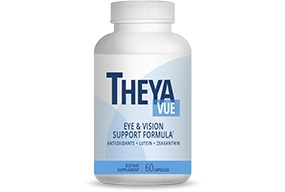
TheyaVue prints the panel, and this desk prints the multiplication
Fourteen nutrients with figures, and a table on the label page that carries the per-capsule column and the per-day column side by side, because the bottle only carries one of them.
One bottle $59 · three bottles $147 · 60-day money-back guarantee
Order TheyaVue On The Official Website60 capsules a bottle · lot THE-26/GO-7323 · ships from the U.S.
The one figure that looks worse than it is
Biotin is the row people notice, because the percent column reads 1,333 percent for one capsule and therefore 2,666 percent for a day. Neither figure is a problem and the reason is worth understanding, because the same logic applies to half the B vitamins on any label.
Daily values for the B vitamins were set at the amount needed to prevent deficiency, which for biotin is 30 micrograms. They are not ceilings and there is no upper intake level for biotin at all, because no adverse effect has been found to set one on. Biotin is water-soluble, cheap, and excreted.
What it does do is interfere with a laboratory. A large family of immunoassays uses the biotin-streptavidin bond as its capture chemistry, and circulating biotin competes with it. A 2020 evaluation of high-sensitivity troponin and thyroid-stimulating hormone assays found the older generation affected at concentrations as low as 40.5 nanograms per millilitre and a newer generation unaffected up to 1,200.
Depending on the assay and the timing, a result can read falsely high or falsely low. Troponin is the test used to rule out a heart attack. That is the whole reason this row is worth a sentence at a blood draw, and it is a sentence, not a reason to avoid the supplement.
Five formats and which ones need the arithmetic
| Format on the shelf | Serving size | Directions | Multiplier |
|---|---|---|---|
| A once-daily capsule | 1 capsule | One a day | 1 |
| A twice-daily capsule | 1 capsule | Two a day | 2 |
| A twice-daily capsule declared per serving of two | 2 capsules | Two a day | 1 |
| A gummy declared per two | 2 gummies | Two a day | 1 |
| A scoop powder | 1 scoop | One or two scoops | 1 or 2 |
All five are legal and all five are common. Only the second and the fifth require the reader to multiply, and neither says so.
Two of those five need a multiplication and three do not, and nothing on the front of any of the five tells you which you are holding. A twice-daily capsule declared per capsule and a twice-daily capsule declared per two capsules can carry identical contents and print panels that differ by a factor of two in every row.
This is the single commonest reason two labels in the same category look incomparable. They usually are comparable; they are just declared differently.
A thirty-second habit for any label
- Turn the bottle to the panel and read the serving size.
- Find the directions, which are usually on a different panel and in smaller type.
- Divide: directions divided by serving size gives the multiplier.
- Multiply the two or three rows you actually care about. On an eye formula that is usually zinc, copper and the carotenoids.
- Check the multiplied zinc figure against 40 mg, counting every other bottle in the cupboard.
- Only then compare it with another product, or with a trial.
It works on the fourteen nutrients that carry a figure. It does nothing for the ten ingredients sharing one proprietary blend line, because there is no number to multiply. That is a different problem and it has its own article.
The bottom line
A Supplement Facts panel is an honest document written in a unit the manufacturer chose. The unit is at the top, the directions are somewhere else on the bottle, and the product of the two is the only figure that matters to the person taking it.
On the label this desk sells, that multiplication turns out mostly flattering: the copper lands exactly on the AREDS figure, the zinc lands between the two amounts AREDS2 compared, and the vitamin C lands well under. It is flattering because the formulation is sensible, not because the panel is generous, and it would read the same way if it were not.
Do the multiplication anyway. It takes thirty seconds and it is the difference between reading a label and looking at one.
This is a dietary supplement website and this article is product information. Nothing here treats, prevents or manages macular degeneration, cataract, glaucoma or any diagnosed eye condition, and nothing here replaces an eye examination. Sight that has changed is a reason to book one.
References
- Age-Related Eye Disease Study Research Group. A randomized, placebo-controlled, clinical trial of high-dose supplementation with vitamins C and E, beta carotene, and zinc for age-related macular degeneration and vision loss: AREDS report no. 8. Arch Ophthalmol. 2001;119(10):1417-1436. PMID 11594942. https://pubmed.ncbi.nlm.nih.gov/11594942/
- Institute of Medicine (US) Panel on Micronutrients. Zinc. In: Dietary Reference Intakes for Vitamin A, Vitamin K, Arsenic, Boron, Chromium, Copper, Iodine, Iron, Manganese, Molybdenum, Nickel, Silicon, Vanadium, and Zinc. Washington DC: National Academies Press; 2001. https://www.ncbi.nlm.nih.gov/books/NBK222317/
- Mzougui S, Favresse J, Soleimani R, Roy T, Gruson D. Biotin interference: evaluation of a new generation of electrochemiluminescent immunoassays for high-sensitive troponin T and thyroid-stimulating hormone testing. Clin Chem Lab Med. 2020;58(12):2037-2045. PMID 32324155. https://pubmed.ncbi.nlm.nih.gov/32324155/
- Age-Related Eye Disease Study 2 (AREDS2) Research Group. Lutein + zeaxanthin and omega-3 fatty acids for age-related macular degeneration: the Age-Related Eye Disease Study 2 (AREDS2) randomized clinical trial. JAMA. 2013;309(19):2005-2015. PMID 23644932. https://pubmed.ncbi.nlm.nih.gov/23644932/
- Magham K, Han J, Eilbert W. Severe copper deficiency anemia caused by zinc supplement use. Am J Emerg Med. 2023;72:222.e1-222.e2. PMID 37640593. https://pubmed.ncbi.nlm.nih.gov/37640593/