TheyaVue Official Website › Blog › Eyebright: A Plant Named For The Job
Eyebright: A Plant Named For A Job Nobody Has Tested It On
Euphrasia officinalis has been called eyebright in English for six hundred years, and it appears on a large share of the eye supplements sold today. Its entire modern clinical record is one randomised trial, which used eye drops rather than capsules, enrolled preterm babies rather than adults, and did not meet its primary outcome. That is worth knowing before paying for it.
The name, and where it came from
Euphrasia officinalis is a small semi-parasitic meadow plant with white flowers marked in purple and yellow. English calls it eyebright. German calls it Augentrost, which means comfort of the eyes. Italian, Spanish and Polish all use names built from the same idea.
The usual explanation is the doctrine of signatures, the pre-modern principle that a plant resembling a body part was intended for it. The flower does look startlingly like an eye, with a dark centre and a pale iris. Whether that is why the name stuck or whether the use came first is genuinely unclear, and it does not matter much either way.
What matters is that the name is doing work on a modern label that the evidence is not doing. A shopper who sees eyebright on an eye supplement reasonably infers that it is there for a tested reason. It is there for a traditional one.
The entire modern clinical record
| What exists for eyebright | What it is | What it can support |
|---|---|---|
| A 2020 randomised trial in 84 preterm neonates | Euphrasia eye DROPS against saline placebo, four times a day for 96 hours | Nothing about an oral capsule in an adult. The primary outcome was not met. |
| A 2014 in vitro study | Eyebright extract applied to human corneal cells in culture | A hypothesis. Cells in a dish are where an idea starts. |
| Six centuries of traditional use | Herbal texts from the fourteenth century onward | That people have used it. Tradition is a reason to investigate, not a result. |
| Its common name | The plant is called eyebright in English and Augentrost in German | Nothing at all. A name is not evidence. |
Four rows, and not one of them supports an oral eye claim. That is unusual to be able to say so cleanly, and it is why this particular ingredient is worth an article.
Four rows is the whole of it. Searches of the published literature for Euphrasia in an ophthalmic context return a small number of records, and when the laboratory work and the botany are set aside, one randomised controlled trial remains.
That is a striking thing to be able to write about an ingredient this common. It is also the sort of statement that should be checkable, so the trial is named and linked below rather than summarised.
What the one trial actually did
The trial ran at the University Children's Hospital in Bern. It was randomised, double-blind and placebo-controlled, which is the right design, and it was properly reported.
The population was preterm neonates presenting with ocular discharge. Eighty-four were randomised out of 114 screened. The intervention was a commercial Euphrasia eye drop preparation, one drop in each eye four times a day for ninety-six hours, against sodium chloride 0.9 percent as placebo.
The primary outcome was treatment success, defined as no ocular discharge at ninety-six hours with no topical antibiotic used during the intervention. Twenty-two of forty in the Euphrasia arm achieved it, against twenty-one of forty-one on placebo. The p value was 0.85.
Some secondary measures trended in the plant's favour and none reached significance. The authors reported it straightforwardly and the trial is a perfectly respectable piece of work. It simply did not find an effect.
Why that trial cannot be transferred to a capsule
- The route is different. A drop is applied to the ocular surface. A capsule is swallowed, digested and distributed by blood. Nothing about the first predicts the second.
- The population is different. Preterm neonates with ocular discharge are not adults with screen fatigue or ageing contrast sensitivity.
- The outcome is different. Resolution of discharge is not visual function.
- The result was negative anyway. Even if all three of the above matched, the trial did not meet its primary outcome.
The laboratory work, described honestly
Beyond the trial there is in vitro work. A 2014 study applied eyebright extract to cultured human corneal cells and measured what happened to them.
That is real research and it is how questions get asked. It is also the level of evidence at which nothing can be concluded about a person. Cells in a dish are not exposed to digestion, first-pass metabolism, plasma protein binding or any of the other things that decide whether a swallowed molecule ever reaches a tissue at a concentration that matters.
The NCCIH guidance on antioxidants makes the same point about the category as a whole, and it is the correct thing to read when a marketing page cites a cell study as if it were a result.
The same five questions, on three botanicals
| Question | Eyebright | Bilberry | Lutein |
|---|---|---|---|
| Is there a randomised human trial? | Yes, one | Yes, several | Yes, several |
| Was it oral? | No, topical drops | Yes | Yes |
| Was it in adults? | No, preterm neonates | Yes | Yes |
| Did it meet its primary outcome? | No | Yes | Yes |
| Is there a published dose to compare against? | No oral dose exists | 240 to 480 mg a day | 10 mg a day |
Three botanicals from the same label, run through the same five questions. The differences are large and they are readable from the published record.
That table is the useful output of this article, because it is a method rather than a verdict. Five questions, asked of any botanical on any label, produce a readable picture in about ten minutes.
Bilberry clears four of the five and fails on the last only because a label declines to print a figure. Lutein clears all five in principle. Eyebright clears one, and the one it clears is the weakest possible version of it.
The contrast matters more than the individual verdicts. A label carrying all three is a label where the evidence behind the ingredients varies by an enormous margin, and the front of the bottle gives no hint of that.
TheyaVue names eyebright, and this desk names what is behind it
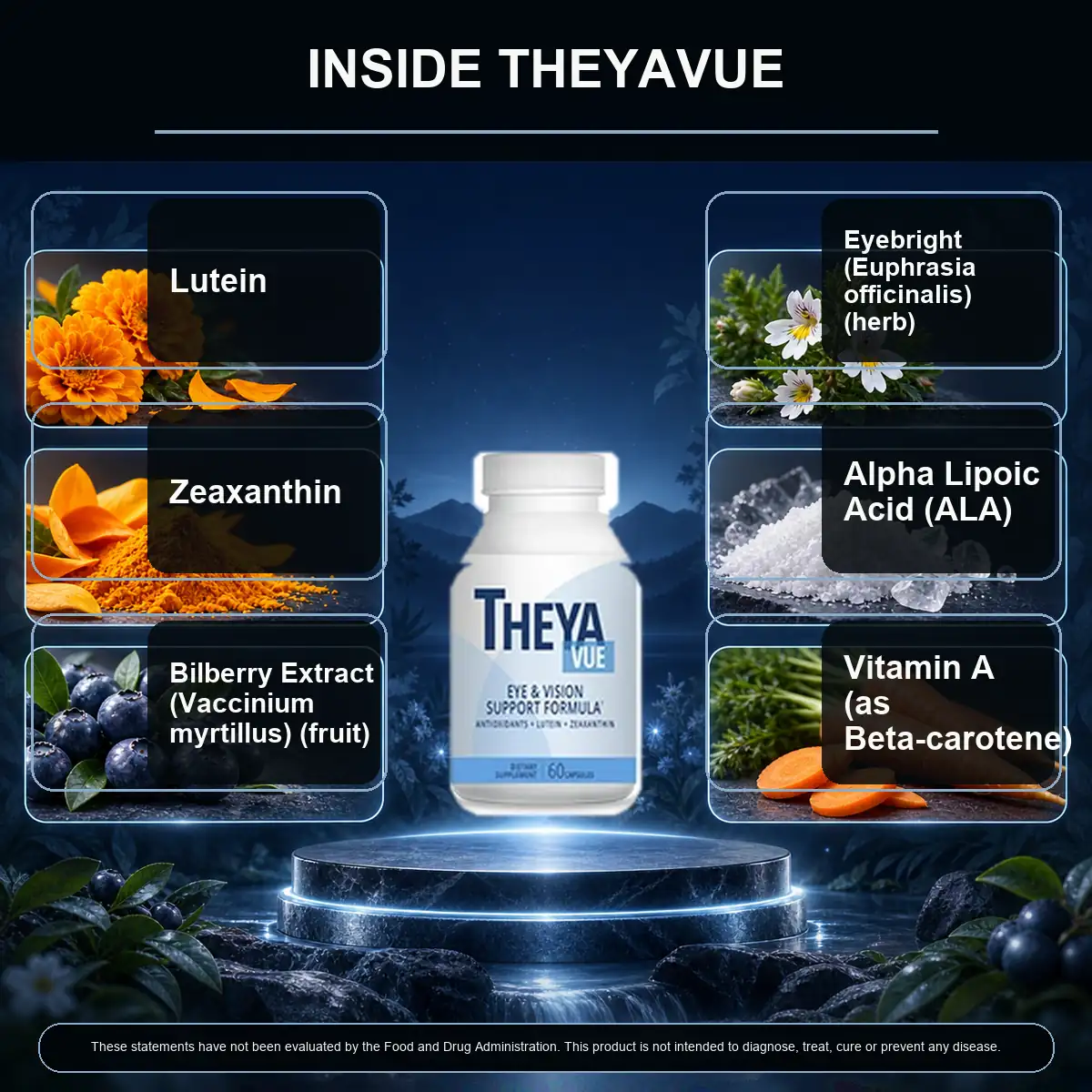
Ten names in one blend, and an ingredients page that takes each of them separately, including the three whose eye evidence is in cells, in animals or in a trial that did not work.
One bottle $59 · three bottles $147 · 60-day money-back guarantee
Order TheyaVue On The Official Website60 capsules a bottle · lot THE-26/GO-7323 · ships from the U.S.
Why it is on the label anyway
Three reasons, and only the third is objectionable.
The first is heritage. Herbal formulation is a tradition as well as an industry, and a formulator building an eye product from the classical materia medica will reach for Euphrasia the way a cook reaches for bay. That is a legitimate thing to do as long as nobody pretends it is something else.
The second is that absence of evidence is not evidence of absence. Nobody has run an oral trial of eyebright in adults with a visual outcome. If somebody did, it might work. The honest position is that the question is open and nobody has answered it.
The third is recognition, and this is where it goes wrong. Eyebright on a label sells because the name tells a shopper what it is for. A plant whose commercial value comes from its name rather than its record is doing marketing work, and a page that lists it among the actives without saying so is letting the name do that work unchallenged. The FTC guidance on health products is worth reading on where the line sits.
What to do with an ingredient like this
- Find out where it sits in the list. On a blend, the order is by weight. An untested ingredient near the top is taking room from tested ones.
- Check whether the seller cites anything for it. A page that names eyebright and cites nothing is at least not overstating. A page that cites the neonate trial without saying it was topical and negative is.
- Do not treat it as a dealbreaker on its own. Most botanical formulas carry one or two traditional ingredients and the question is whether the tested ones are also there.
- Weight your decision on the ingredients that do have evidence. If the carotenoids and the bilberry are the reason to buy, judge the product on them.
- Notice the pattern rather than the item. A formula where the untested ingredients are the ones in the advertising is a different proposition from one where they are supporting cast.
Bilberry's night-vision reputation also came from a story rather than a trial, and when somebody finally examined it in placebo-controlled trials the effect was not there. The difference is that bilberry then acquired two decent modern trials on a different outcome. Eyebright has not, yet.
The bottom line
Eyebright is on eye supplements because it is called eyebright. Its one modern randomised trial used drops, in babies, and did not meet its primary outcome. Its remaining record is a cell-culture study and six centuries of herbal tradition.
None of that makes it harmful and none of it makes a formula containing it a bad formula. What it means is that the ingredient should not be carrying any weight in a buying decision, and a page that presents it alongside lutein without distinguishing the two is flattening a genuine difference.
Ask the five questions in the table above. They take ten minutes and they work on every botanical on every label in this category.
This is a dietary supplement website and this article is product information. Nothing here treats, prevents or manages macular degeneration, cataract, glaucoma or any diagnosed eye condition, and nothing here replaces an eye examination. Sight that has changed is a reason to book one.
References
- Meier-Girard D, Gerstenberg G, Stoffel L, et al. Euphrasia eye drops in preterm neonates with ocular discharge: a randomized double-blind placebo-controlled trial. Front Pediatr. 2020;8:449. PMID 32850558. https://pubmed.ncbi.nlm.nih.gov/32850558/
- Paduch R, Wozniak A, Niedziela P, Rejdak R. Assessment of eyebright (Euphrasia officinalis L.) extract activity in relation to human corneal cells using in vitro tests. Balkan Med J. 2014;31(1):29-36. PMID 25207164. https://pubmed.ncbi.nlm.nih.gov/25207164/
- National Center for Complementary and Integrative Health. Antioxidants: In Depth. National Institutes of Health. https://www.nccih.nih.gov/health/antioxidants-in-depth
- Canter PH, Ernst E. Anthocyanosides of Vaccinium myrtillus (bilberry) for night vision - a systematic review of placebo-controlled trials. Surv Ophthalmol. 2004;49(1):38-50. PMID 14711439. https://pubmed.ncbi.nlm.nih.gov/14711439/
- Federal Trade Commission. Health Products Compliance Guidance. December 2022. https://www.ftc.gov/business-guidance/resources/health-products-compliance-guidance