TheyaVue Official Website › Blog › Do Eye Vitamins Really Work? What the Big Trials Found
Do Eye Vitamins Really Work? What the Big Trials Found
Quick answerIt depends on who you are. In people who already had macular degeneration, the AREDS formulas were tested for slowing progression. In healthy adults, trials of lutein and zeaxanthin measured better contrast and glare recovery, not sharper letters. Nothing here shows vitamins treat cataract or restore lost sight. TheyaVue is not an AREDS formula.
- AREDS and AREDS2 tested specific formulas in people who already had macular degeneration. They did not test healthy eyes.
- AREDS used vitamin C 500 mg, vitamin E 400 IU, beta carotene 15 mg, zinc 80 mg and copper 2 mg a day.
- AREDS2 added lutein 10 mg and zeaxanthin 2 mg a day for five years, and tested a 25 mg zinc arm.
- Studies in healthy adults looked at contrast sensitivity, glare recovery and visual speed. None reported a line gained on a letter chart.
- Two Cochrane reviews, on slowing progression and on prevention, read differently because the people differ.
- TheyaVue is not an AREDS formula and inherits none of their findings.
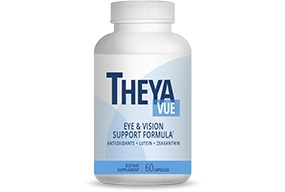
Curious how one eye capsule is built?
The order page shows the TheyaVue packs and the 60-day guarantee. The label prints 14 of its amounts and hides ten.
See today's price and guarantee
Disclosure: Gotheyavue is paid when a sale comes through this site. The seller's checkout sets the final price.
Which question are you really asking?
Do eye vitamins work is not one question. It is at least three, and the answers differ.
- If you already have macular degeneration, does a vitamin formula slow it down?
- If your eyes are healthy, can a supplement stop that disease from starting?
- If your eyes are healthy, can a supplement change how you see, such as contrast or glare?
The big trials answer the first. The second has a weaker answer. The third has small trials with careful measures. Mixing the three is how a headline about one study ends up on a bottle that was never tested. It is also why the questions do vision supplements work and which vision supplements that work have no single honest answer. We will take them in order.
What did the AREDS trials test?
AREDS ran a high-dose formula in people with age-related eye disease, and its report AREDS report 8 is the one everybody quotes. The formula was vitamin C 500 mg, vitamin E 400 IU, beta carotene 15 mg, zinc 80 mg and copper 2 mg a day. The copper was paired with the zinc on purpose.
The follow-up, the The AREDS2 trial, dropped the beta carotene. The reason is a hard one: in smokers, trials with beta carotene at 20 to 30 mg a day found more lung cancer. AREDS2 added two carotenoids, lutein at 10 mg and zeaxanthin at 2 mg, to the daily dose and followed people for five years. It also ran a 25 mg zinc arm and found no difference from the 80 mg arm. A ten-year follow-up and a 2025 re-analysis of both trials came after.
| Formula | Who took part | What was in it |
|---|---|---|
| AREDS | People with age-related eye disease | Vitamin C 500 mg, vitamin E 400 IU, beta carotene 15 mg, zinc 80 mg, copper 2 mg a day |
| AREDS2 | People who already had intermediate macular degeneration | Lutein 10 mg and zeaxanthin 2 mg a day for five years, with a 25 mg zinc arm |
| TheyaVue | Healthy adults, by its own label | Vitamin C 200 mg, vitamin E 20 mg, zinc 32 mg and copper 2 mg a day, plus a 240.5 mg blend with no individual amounts |
The TheyaVue row is the panel figure doubled. The AREDS rows are trial amounts.
Read the third row against the first two. The copper matches. The zinc sits above the 25 mg arm and well below the 80 mg one. The two vitamins are a fraction of the trial amounts. So the findings of those trials do not carry over to this bottle.
Do vitamins slow or prevent macular degeneration?
Slowing and preventing are different questions, and two Cochrane reviews show it. One looks at slowing progression. The other looks at prevention. They read differently because the people differ. The first group already had the disease. The second did not.
That is the honest line. For people with intermediate disease, a specific formula has trial support, and your ophthalmologist is the person to name it. For healthy people, our sources do not support prevention. The National Eye Institute is the right place to start if you have been given a diagnosis.
It follows that a supplement is not near the top of the list of things that protect sight. An eye exam, not smoking, sunglasses, blood pressure and blood sugar control, a good screen setup and eating greens all do more, with better evidence. Our eye health guide ranks them.
Do eye vitamins improve vision in healthy people?
The honest answer is that some measures moved and the letter chart did not. Four trials of lutein and zeaxanthin in healthy young adults are the best evidence:
- A year-long contrast study put healthy adults aged 18 to 25 (59 of them) on 12 mg or 24 mg of total macular carotenoids every day.
- A glare and photostress trial had 115 young healthy adults take lutein and zeaxanthin together, at 10 mg and 2 mg each day, for one year.
- A processing-speed study of 69 young healthy adults ran four months.
- A dose study in 28 healthy adults showed macular pigment rising at every amount tested over 12 weeks.
Those results are about contrast, glare recovery and speed. They are not about reading a smaller line. The chart tests black letters in good light, which is the one thing hardly anyone complains about. So if a vitamin ad promises sharper letters, the trials do not back it.
Notice also who took part. The people were young and healthy. A middle-aged reader with a different diet, or an older one, may not behave the same way. That is one more reason to read trial results as hints.
What about cataract, dry eye and other conditions?
Cataract has its own report inside AREDS2, listed as AREDS2 report 4, on cataract. The sources we use do not print its result, so we do not describe it. What we can say is that TheyaVue does not treat, prevent or slow cataract, glaucoma or macular degeneration, and that the National Eye Institute page on cataract lists the few things that do make a difference, such as not smoking and controlling blood sugar.
Dry eye is similar. None of our sources tests these ingredients as a treatment for it. If you are searching for vitamin eye drops, note that carotenoid capsules are swallowed and not placed in the eye.
If your sight changes, see an eye doctor first. A supplement should not be the first response. A dilated eye exam finds conditions that no vitamin has anything to do with. See an eye doctor first.
Are eye vitamins worth it, then?
Worth is personal. Here is a short way to decide.
- If you have macular degeneration, ask your ophthalmologist which formula they name. Do not swap it for a general product.
- If your diet has few greens, a carotenoid supplement can be a reasonable thing to add after the free steps.
- If you want a precise, trial-matched amount, check whether the label prints it. TheyaVue does not for lutein or zeaxanthin.
- If you want a promise of better sight, no honest source will give you one.
Eight questions that work on any label are in our guide to choosing an eye supplement, and our worth-it guide applies them to TheyaVue.
Where do these facts come from?
Every trial fact here is traced to a study linked in the text or gathered in the list below, plus this site's ingredient, eye health and how-it-works pages. The TheyaVue figures come from its label.
- AREDS report 8. https://pubmed.ncbi.nlm.nih.gov/11594942/
- The AREDS2 trial. https://pubmed.ncbi.nlm.nih.gov/23644932/
- The AREDS2 ten-year follow-up. https://pubmed.ncbi.nlm.nih.gov/35653117/
- The 2025 re-analysis of both AREDS trials. https://pubmed.ncbi.nlm.nih.gov/39025435/
- The Cochrane review on slowing progression. https://pubmed.ncbi.nlm.nih.gov/37702300/
- The Cochrane review on prevention. https://pubmed.ncbi.nlm.nih.gov/28756617/
- The National Eye Institute on macular degeneration. https://www.nei.nih.gov/learn-about-eye-health/eye-conditions-and-diseases/age-related-macular-degeneration
- A twelve-month contrast-sensitivity trial. https://pubmed.ncbi.nlm.nih.gov/28431432/
- The glare and photostress trial. https://pubmed.ncbi.nlm.nih.gov/25468896/
- A study of visual processing speed. https://pubmed.ncbi.nlm.nih.gov/25483230/
- The three-dose macular pigment study. https://pubmed.ncbi.nlm.nih.gov/27426932/
- AREDS2 report 4, on cataract. https://pubmed.ncbi.nlm.nih.gov/23645227/
- The National Eye Institute on cataract. https://www.nei.nih.gov/learn-about-eye-health/eye-conditions-and-diseases/cataracts
Frequently asked questions
Do eye vitamins really work?
It depends on who takes them. In people with intermediate macular degeneration a specific formula was tested for slowing progression. In healthy adults, trials measured contrast and glare recovery, not letter-chart sharpness.
Do eye vitamins improve eyesight?
None of the trials we use reports a letter-chart line gained, and a capsule cannot alter how the lens focuses light.
Are eye vitamins worth taking?
Ask your eye doctor first. An eye exam, not smoking and sunglasses do more, and a supplement can be an extra if your diet has few greens.
Do eye supplements help cataracts?
TheyaVue does not treat, prevent or slow cataract. See an eye doctor and read the National Eye Institute page on cataract.
Is TheyaVue the same as AREDS2?
No. AREDS2 tested six named ingredients at set doses in people with macular degeneration. TheyaVue is a different formula with 24 names, so it does not inherit those findings.
Are vitamin eye drops the same as capsules?
No. TheyaVue is a capsule you swallow. It is not a drop and does not go in the eye.
Our view
Do eye vitamins really work? In the one place they were tested hardest, in people with intermediate macular degeneration, a specific formula has trial support for slowing progression. In healthy eyes the findings are smaller and sit in contrast, glare and speed. Nobody should promise better letters.
That is the frame to put round any bottle, ours included. Ask who the trial enrolled, what amount it used and which measure moved. Then ask whether the bottle in your hand prints that amount. TheyaVue prints 14 of its amounts and hides ten.
As a seller we gain from sales. Book an eye exam if you have not had one, and ask your own doctor about any formula.
Want to try a simple daily routine?
If you have had your eyes checked and want to try it, the order page shows current prices and the 60-day terms.
See today's price and guarantee
Disclosure: Gotheyavue is paid when a sale comes through this site. The seller's checkout sets the final price.
TheyaVue is a dietary supplement. It is not a drug and it is not FDA approved, and no supplement is. Nothing on this page treats, cures or prevents any disease, and nothing here replaces an eye examination or advice from your own doctor. Ask a doctor about any medical question, and book an eye examination if your sight has changed.
Last updated